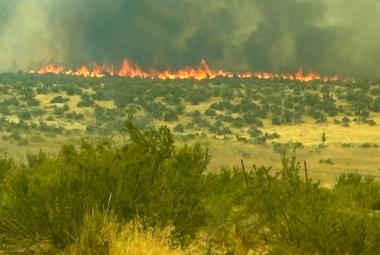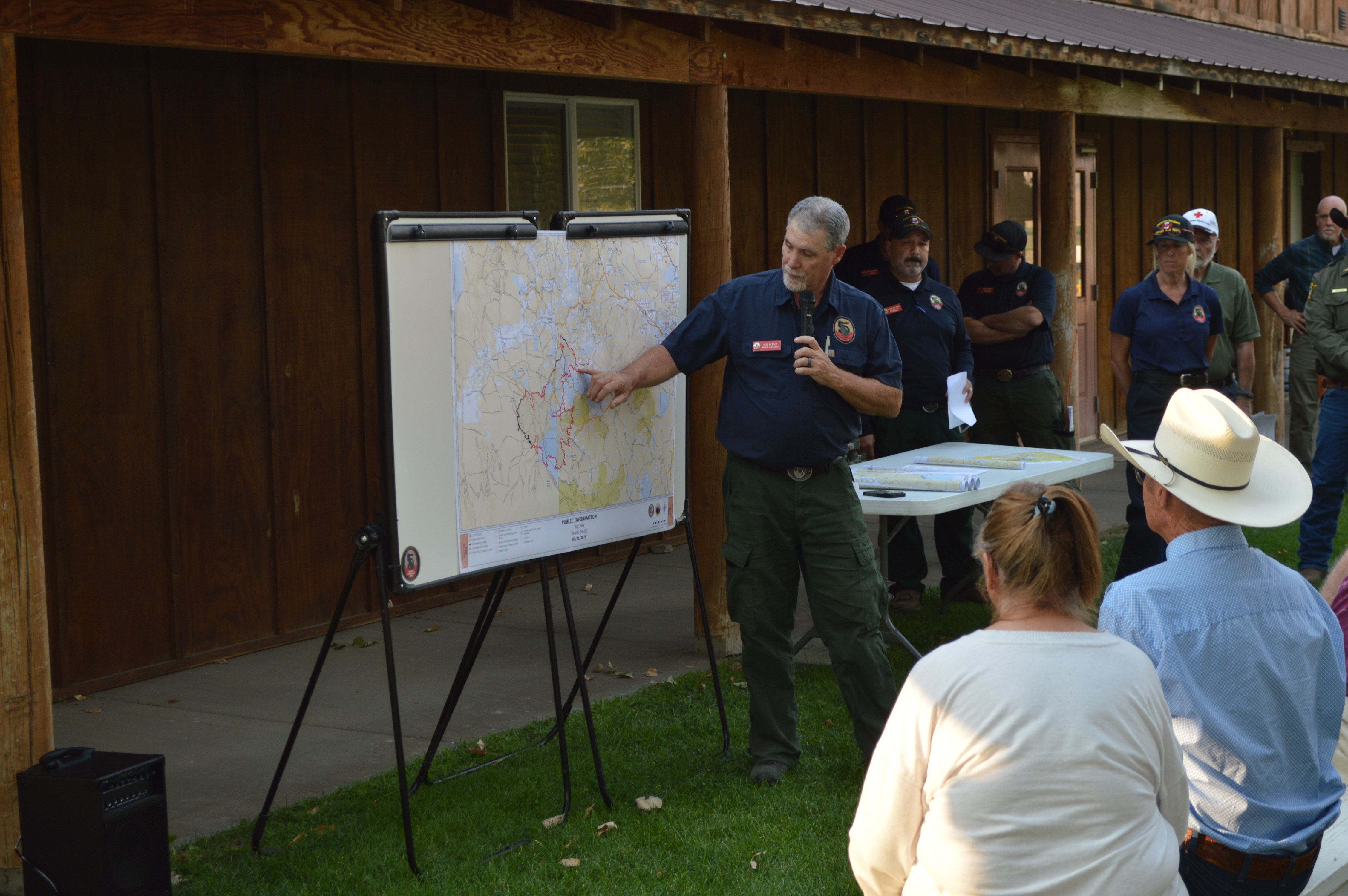
Officials delivered optimism with a caveat during Friday’s Big Grass Fire community meeting in Murphy.
Amid the roar of helitack copters landing at the nearby airstrip, officials with Interagency Incident Management Team 5 gave about three dozen community members a situation update on the Owyhee County Historical Museum’s lawn.
Team 5 public information officer Julie Rider said the 304,237-acre fire was at about 21 percent containment.
The containment is on the west side of the fire in Idaho, and more containment is expected on the northwest perimeter of the fire near the Owyhee River drainage Incident Team 5 official Jaime Hidalgo said. Drones with infrared capabilities could be deployed to track the drainage, he added.
But officials warned that a dry cold front expected in the area Saturday could whip up wind gust of 30 mph and possibly spread the fire.
“We are getting wind tomorrow. A lot of wind,” Incident Team 5 Cmdr. Alex McBath said. “We call it a PDS — a pretty dangerous situation.”
The winds are expected out of the southwest, and McBath said the weather could push the fire to the east.
The peak time for the winds is expected to be between 3 p.m., and 6 p.m., on Saturday, McBath said. After subsiding for a few hours, winds could pick up again Sunday morning.
As of Friday night, the Triangle area was a “Go” evacuation mode, while Silver City sat a “Set” level, but McBath said that area’s residents could receive a “Go” alert, too.
McBath said some of the 551 firefighters on the lines have done “a ton of work” off Flint Creek Road to the south to South Mountain.
“All it takes is one little speck, but we’re ready if it gets to Flint,” he said.
The fire could also move into the North Fork Owyhee Wilderness, McBath said. That would bring rangeland and timber and juniper into play.
Federal firefighting commanders have already stationed some of the 71 engines on assignment at ranches near the wilderness to protect structures.
All officials who spoke said the priority was protecting life and property.
Hidalgo examined the perimeter of the fire in Idaho.
He said the east side of the fire is the most problematic. Hot Shot crew and Type 2 firefighting crews are dealing with difficult terrain. Air assets are being used on the that segment of the fire, too.
Hidalgo said aircraft concentrated on the area of Boulder Creek all day Friday.
He said the South Mountain resource was “largely intact” because of elevation changes and the type of vegetation in that region holds more moisture and there is less heat.
The challenge for firefighters in the Juniper Mountain area is a lot of heat and difficult terrain, Hidalgo said, adding that the “great distance” between the mountain the road system doesn’t help in moving personnel and assets.
— JPB